Salon furniture materials: what survives a wet room and a solvent
A salon finish is asked to survive three things that rarely appear together in a catalogue: standing water, a solvent that is poured rather than wiped, and a dye designed to be permanent. The material that handles one is often the material that fails the next.
The choice is usually made from a sample card, which is the one place none of those exposures exists. What follows is the order to think in, and where each finish gives up.
Three exposures, not one
Water is the easiest to plan for, because it arrives in the same place at the same time every day. Solvent is harder, because it arrives on a cotton pad in small amounts and sits on the surface for a minute. Dye is hardest of all, because it does not have to damage the finish to ruin it; it only has to go in.
- Standing water at a basin, on a wet floor and around a pedicure chair, which finds every unsealed edge.
- Solvent from remover, primer and acetone, which softens a lacquer and dulls a laminate over months rather than minutes.
- Dye and peroxide from colour work, which stain a porous edge and bleach a dark surface where a drop sits.
The five finishes, and where each one fails
Each line below is a verdict on the material rather than on a supplier, because the grade behind a name moves. A laminate is a core, a decor paper and a resin, and two laminates from one sample card can differ at the edge.
| Finish | Good at | Where it fails |
|---|---|---|
| Laminate on a board core | Cost, colour range, a flat face that can be replaced | The edge and any cut, where water reaches the core |
| Compact laminate | Water through the core, and an edge of the same material | Weight, and a narrow range of thicknesses |
| Solid surface | Joints that can be sanded out, water, and a surface that can be refinished | Heat, and strong solvent left standing |
| Vinyl upholstery | Wiping, and most of what a salon spills | Cold, seams, and solvent that stays in contact |
| PU upholstery | Softness and skin comfort on a treatment bed | Solvent resistance, which is lower than vinyl |
Coated steel belongs beside them, since every frame, leg and bracket is one. Powder coat chips at a weld and at a foot, and the rust that follows starts where the coat broke rather than where the water is.
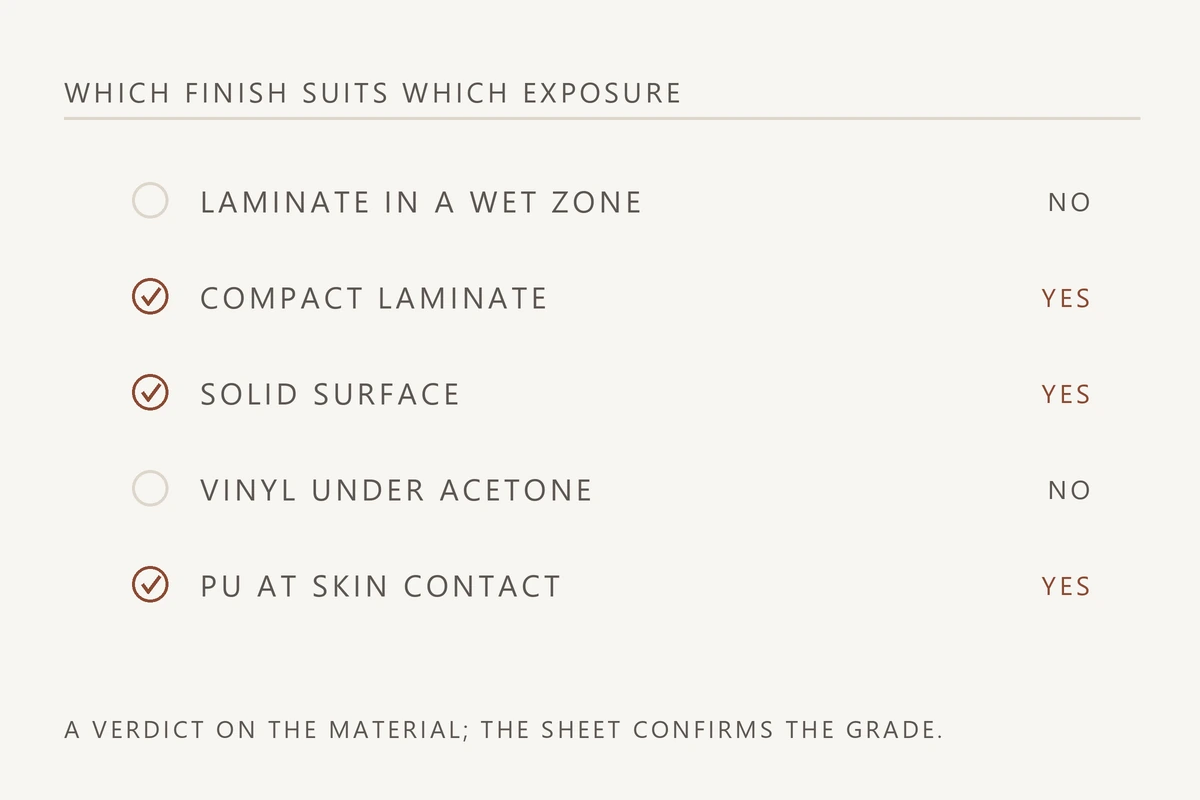
The verdicts that matter most are short. Laminate belongs in a dry zone and not around a basin. Compact laminate and solid surface both take standing water, and the difference between them is the joint and the weight. Vinyl takes a spill and does not take acetone left on it. PU is the right surface where skin rests for an hour and the wrong one where a remover bottle lives.
A dry zone is not a lesser specification either. A reception desk, a retail shelf and a cabinet back panel are all better in a laminate than in a solid surface, because the budget is better spent at the pieces that get wet.
Joints and edges decide a material
A finish is usually chosen from its face and judged on its edge. Water does not damage a laminate face; it reaches the core through a cut, a screw hole or a band that has lifted, and the core swells where nobody can see it. The same is true of a cabinet back panel and of the underside of a top.
The specification should name the edge treatment rather than the face: a postformed edge, a band of a stated thickness, a sealed cut, a silicone upstand where the top meets the wall. Two quotations for the same desk can differ entirely on that line and look identical on the board.
Match the finish to the piece
Every piece in a salon meets a different mix, so one finish across a whole order is either over specified or under specified.
- Reception desk. A hard face for keys and bags, and a top that survives a remover bottle set down without its lid.
- Manicure table. Acetone every day, so a compact laminate or a solid surface top, and an edge that cannot wick.
- Pedicure chair. Water and dye, so vinyl on the seat and a base that can be wiped down to the floor.
- Treatment bed. Oil and skin contact, so PU on the cushion and a frame that is coated rather than polished.
- Display cabinet. Light and glass, with a shelf surface that does not mark where a bottle has stood for a year.
What to send before a finish is chosen
Five items turn a finish conversation into a specification, and four of them are photographs.
- The products used at the station, with the label, because the solvent in one brand is not the solvent in another.
- The cleaning agent the studio uses, since a daily disinfectant is an exposure of its own.
- A photograph of the room, which shows the water, the daylight and the colour direction.
- The colour direction as a reference rather than a name, because a finish name means nothing across suppliers.
- Which piece is allowed to look worn, and which one must not, since not every surface needs the same budget.
Grades, thicknesses and warranty terms are not published here. They are confirmed per data sheet, and the finish and the edge treatment are confirmed at quotation.
Updated 2026-10-25 · 4 min read. Specifications are revised without notice; confirm the current sheet before a tender document is published.
Builds this guide applies to
The build sheets where these decisions turn into a specification.
Questions that come back
Short answers, before the email.
Is solid surface better than laminate?
For a wet zone, usually, because the joint can be made invisible and the surface can be sanded. For a large dry area it costs more than the exposure justifies. The question is which pieces see water, not which material is better in general.
Can vinyl be repaired?
A small puncture can be filled and a seam that has opened can be re-sealed by a technician. A burn or a solvent stain cannot, which is why a damaged seat is usually replaced rather than repaired.
How do I compare two samples that look the same?
By the parts that are not the face: the core, the edge band, the backing, the thickness and the fire or abrasion statement on the sheet. Two samples can look identical and behave differently at the first spill.
Does colour affect durability?
Not the material, but what shows. A dark top shows every scratch and a light one shows dye; a mid tone hides both, which is why it is the usual compromise for a working surface.
Related
Where to go next
Send the room, get the sheet.
Measurements, the working side and the destination market are enough to start.