Manicure table extraction: what the hood catches and what it leaves
A manicure table with extraction is two pieces of equipment in one housing: something that pulls dust away from the bit, and something that carries vapour out of the room. They are not the same job, and a table that does one well can do the other badly.
A nail station produces two things that have to leave the working area, and they behave in opposite ways. Dust from filing is heavy enough to settle on the table and light enough to stay airborne for minutes. Vapour from monomer, primer and remover is invisible, spreads through the room, and is not caught by a filter chosen for dust.
A table can only be specified once that difference is understood, because the two streams need different capture, different media and often a different fan.
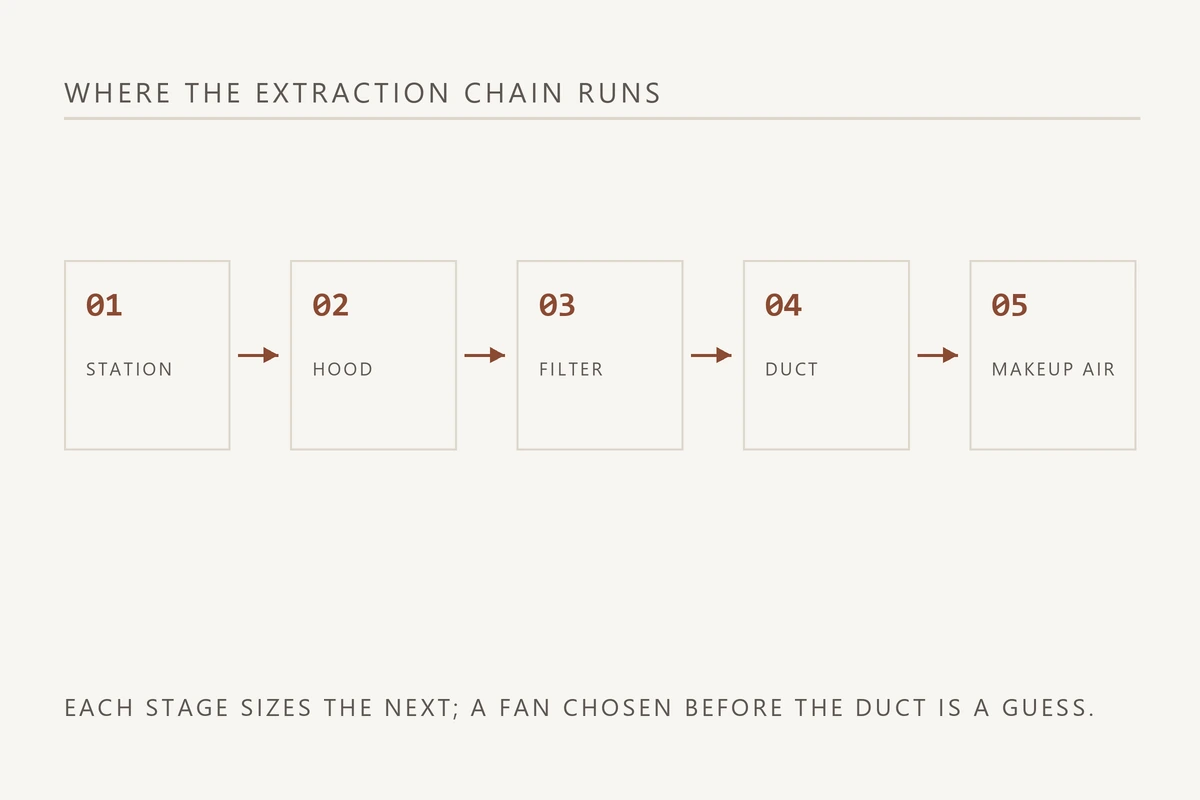
Dust and vapour are two streams
Particles are captured by moving air close to the source, at a speed high enough to carry them before they spread. Vapour is captured by changing the air in the room, which is a volume question rather than a speed question. A small fan with a good hood can win the first and cannot win the second.
| Stream | Captured by | Held by |
|---|---|---|
| Filing dust | Air moving at the bit and at the hand | A fine particle filter |
| Gel and acrylic vapour | Room air changes, and a hood near the hand | Activated carbon, or discharge outside |
| Spray aerosol | A hood above the station | A filter rated for it |
| Remover odour | Discharge outside, or carbon | The same carbon that may already be spent |
The last row is where tables fail quietly. Carbon has a capacity, and once it is used up it stops holding vapour while the fan keeps running and the room keeps smelling. A filter change schedule belongs in the specification, not on the accessory list.
Capture at the bit
A hood is only useful where the dust actually is. A grill at the back of the table pulls air across the client's hands, which is the right direction, but capture falls off with distance, so a hand working at the front edge sits outside the useful zone. That is why the better tables add a second intake near the working surface or a low hood that follows the hand.
- The intake sits behind and below the hand, so dust is drawn away from the client's face.
- The grill comes out without tools, because a grill that needs a screwdriver is a grill that stays loaded.
- A tray or a bag under the grill catches what falls; a table without one sends it into the fan.
- The switch is within reach of the technician, not under the table.
Filter, duct or both
Three arrangements cover most stations, and the choice follows where the air may go rather than which table looks better.
- A filter unit on the table. Air is cleaned and returned to the room. Simple, no duct, and dependent on the filter being changed; it does nothing for vapour once the carbon is spent.
- A duct to outside. Both streams leave the building. It needs a route, a fan sized for the run, and a discharge point that is not under a window that opens.
- A filter and a duct. Heavy dust is caught at the table and the remaining air goes outside, which keeps the duct cleaner and the fan quieter for longer.
The stream that matters most is the one nearest a face. Filing happens within arm's length of two people, and the finer the grit the longer the dust stays up. A hood that clears the table but leaves the air at chin height unchanged has moved the dust rather than removed it, which is why capture at the source is worth more than a larger filter downstream.
The person at the table is not the only one in the room either. Dust that escapes the hood travels, settles on shelves, and is picked up again the next time a door opens. Capture near the source is the only stage where the amount getting away is still small enough that the room can absorb it.
The room side: makeup air and noise
Every cubic metre the extraction removes has to come back in from somewhere. In a sealed room it arrives through a door gap, a drain trap or a flue, and it arrives cold, dirty and sometimes down a flue in the wrong direction. A supply path, a door grille or a dedicated intake is part of the extraction design.
Noise is the other half. The fan is often the loudest thing in a nail studio, and a fan that is too small for its duct runs at a speed that makes it louder. Siting it outside the treatment area, or in a cupboard with a proper air path, costs less than replacing it after the first complaint.
What the enquiry has to include
A supplier can size an arrangement from five answers, and none of them is a preference.
- The number of stations, and whether each has its own unit or shares a duct.
- Where the air may be discharged: wall, roof, or back into the room.
- The route a duct could take, including the bends and the length.
- The filter change interval the studio can keep, and who does it.
- The supply voltage and the socket position, and whether an isolator is required.
Duties, filter grades and fan noise are not published here. They are confirmed per data sheet, and the arrangement, the duct run and the discharge point are confirmed at quotation.
Updated 2026-10-25 · 4 min read. Specifications are revised without notice; confirm the current sheet before a tender document is published.
Builds this guide applies to
The build sheets where these decisions turn into a specification.
Questions that come back
Short answers, before the email.
Does a manicure table with a filter still need a duct?
Not always. A filter unit returns air to the room and is enough for dust when the filter is changed on schedule. Vapour is the limit: carbon holds a finite amount, and a room with several stations and no discharge outside will reach it. The question is what the room can tolerate, not what the table can hold.
Can two tables share one fan?
Yes, if the duct is sized for both and the run is balanced, and many studios do it that way. The risk is that one station closes its shutter and the other loses capture, so a shared system needs a damper per station or a fan sized with both open.
Where should the discharge go?
Outside, above the level of any opening that can be opened, and away from where people stand. A discharge into a courtyard or under a window moves the problem instead of solving it.
What filter grade does a nail table need?
The grade that matches the dust the studio actually makes, stated per data sheet. A filter finer than the fan can pull through loads quickly and starves the hood, which is worse than a slightly coarser one that is changed on time.
Related
Where to go next
Send the room, get the sheet.
Measurements, the working side and the destination market are enough to start.